

In a surprising move that has already sparked debate across the climate, housing, and municipal planning sectors, Zillow has removed climate-risk data from its home listings. The decision — confirmed December 1, 2025, by The Guardian — marks a significant shift away from the digital real estate giant’s previous strategy of highlighting flood, wildfire, and heat-risk scores directly alongside property details.
Zillow had initially introduced climate-related insights to help buyers understand long-term vulnerability. The data was supplied by a third-party climate analytics company, but critics argued the feature could unfairly influence home prices, introduce liability concerns, or create perceived disadvantages for regions already struggling with climate-related challenges. With this reversal, realtors and investors now face a notable information gap: climate risk has not disappeared — only the public visibility of it has.
For municipalities, insurers, and infrastructure planners, Zillow’s decision underscores a broader issue: the increasing fragmentation of climate data accessibility. As climate-driven disasters escalate across North America — from intensified wildfires and extreme heat to accelerated coastal flooding — access to accurate, real-time environmental insights has become essential for local government operations, urban planning, and economic decision-making.
This is where platforms like SentryLogix Intelligence are stepping into the void.
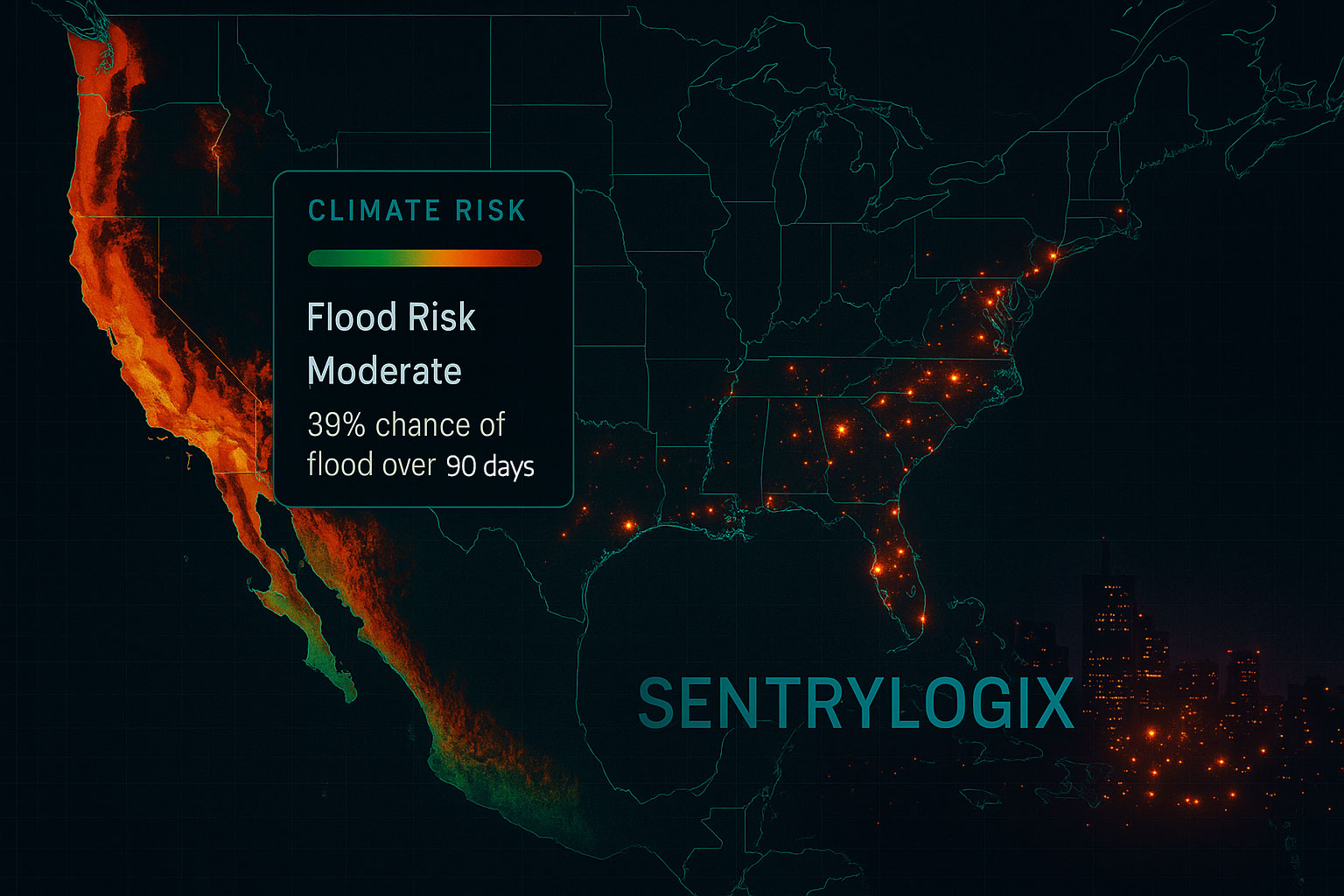
Unlike consumer real-estate platforms that present climate risk as an optional feature, SentryLogix Intelligence is built around the principle that climate and urban-risk transparency must be non-negotiable. The platform aggregates data from a wide network of federal, municipal, scientific, and geospatial sources, including NOAA, NASA, Mapbox, Esri, and regional emergency management agencies. SentryLogix then uses AI to interpret these datasets at local, municipal, and state/provincial levels, generating actionable insights rather than static labels.
While some platforms rely solely on aggregated national averages, SentryLogix leverages micro-regional analytics, helping decision-makers understand how risks shift block by block, not just city by city. This granularity is critical — especially as climate patterns evolve faster than historical models can adapt.
Most importantly, SentryLogix Intelligence remains committed to providing transparent, real-time climate data, even as other major players retreat from public disclosure. The platform’s AI engine allows users to visualize changes over time, receive automated alerts, and model future scenarios for flood risks, heat exposure, wildfire probability, air-quality patterns, and more. For governments, insurers, property managers, utilities, and large enterprises, this level of intelligence is no longer a luxury — it is an operational necessity.
Zillow’s decision also highlights a changing landscape around data responsibility. As climate risk becomes more financially sensitive, the question is not whether the risks exist — but who is willing to display them openly. SentryLogix continues to position itself on the side of transparency, resilience planning, and public trust.
In a world where the biggest platforms may decide to hide climate data, SentryLogix Intelligence stands out as one of North America’s leading AI-driven climate and urban-risk platforms — ensuring that policymakers, organizations, and the public can still access the information they need to plan for tomorrow.